Multi-agent: when to split agents and when not to
In this article
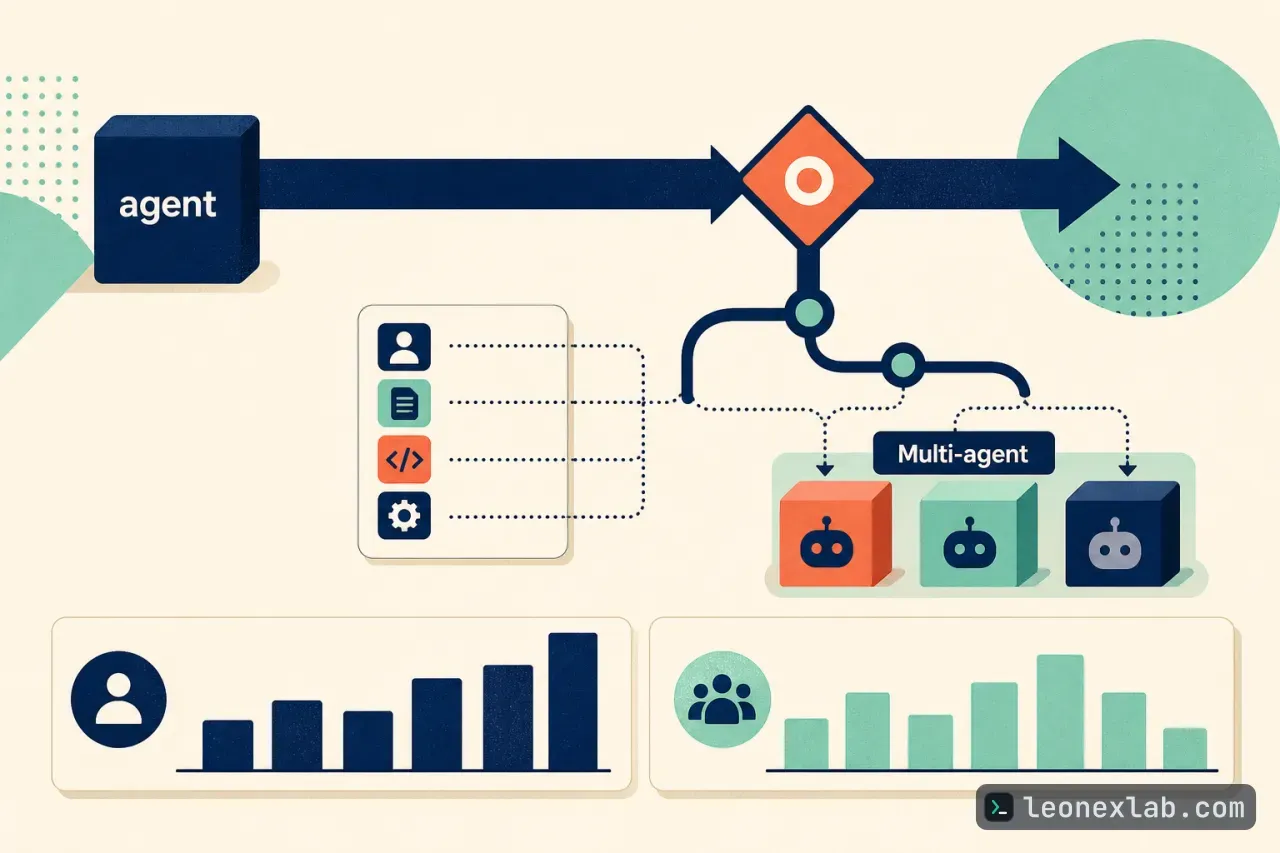
In AI agent systems, breaking things into multiple agents sounds modern, but in practice it often makes testing and debugging harder and drives up costs. The guiding principle: start with one agent, split only for a specific reason, and always measure to confirm that decision. The principles below are not tied to any framework, because framework names change faster than these principles do.
Default: one agent with a lean toolset
A single agent holds the full context of the conversation, so you avoid two agents interpreting the same request in two different ways. When something goes wrong, the developer only has to trace a single chain of reasoning. Splitting agents makes sense only when you can point to a specific reason; the feeling that the architecture looks more professional is not a reason.
Four situations where you should split agents
Signs you have split too much
Handoff rules between agents
Once you have split, you need to specify clearly what gets passed from one agent to another. At a minimum there should be four parts:
the goal to be achieved
the data already available
what has been done
what remains to be done
A short, structured handoff note is always better than dumping the entire conversation history across. This note also serves as a check: if the receiving agent has to ask about something the previous agent already knew, the handoff template is missing a field and needs to be reviewed.
Verify the decision with numbers
Key points
By default, use one agent with a lean tool list, because the context is unified and it is easier to debug.
Split only for a specific reason: too many tools, different permissions, long tasks that generate a lot of intermediate output, or two jobs that can run in parallel.
Hand off through a short, structured note; set limits on the number of steps and handoffs, then pass the task to a human when a limit is reached.
Compare the two approaches on the same set of real questions; if multiple agents are not clearly better, go back to a single agent.