A security model for AI-driven automated pentesting
In this article
A wave of LLM-based pentest frameworks erupts
ARTEX is an open-source agentic pentest system that automates cyber-attack workflows. Its author, Autumn-27, took down the original repository on October 8, saying that malicious use of the tool runs completely against the original intent. The ecosystem then fragmented quickly: there are now more than 12,000 repositories, including a few hundred forks descended from the original repository.
Since October 8, hundreds of similar orchestration frameworks have also appeared. Daily request volume from AI-powered pentest and exploitation tools has risen 30x since October 1. Some complex attacks even chain together stolen customer credentials, such as lateral movement (moving sideways within the target environment).
According to data observed up to November 12, ARTEX and its forks account for more than 60% of known AI pentest orchestrators. Since the original repository was taken down, traffic has grown more than tenfold. The number of unique instances spiked around October 8, which may be a hydra effect: removing the original spawned countless forks and modifications.
How LLM-based pentest orchestrators work
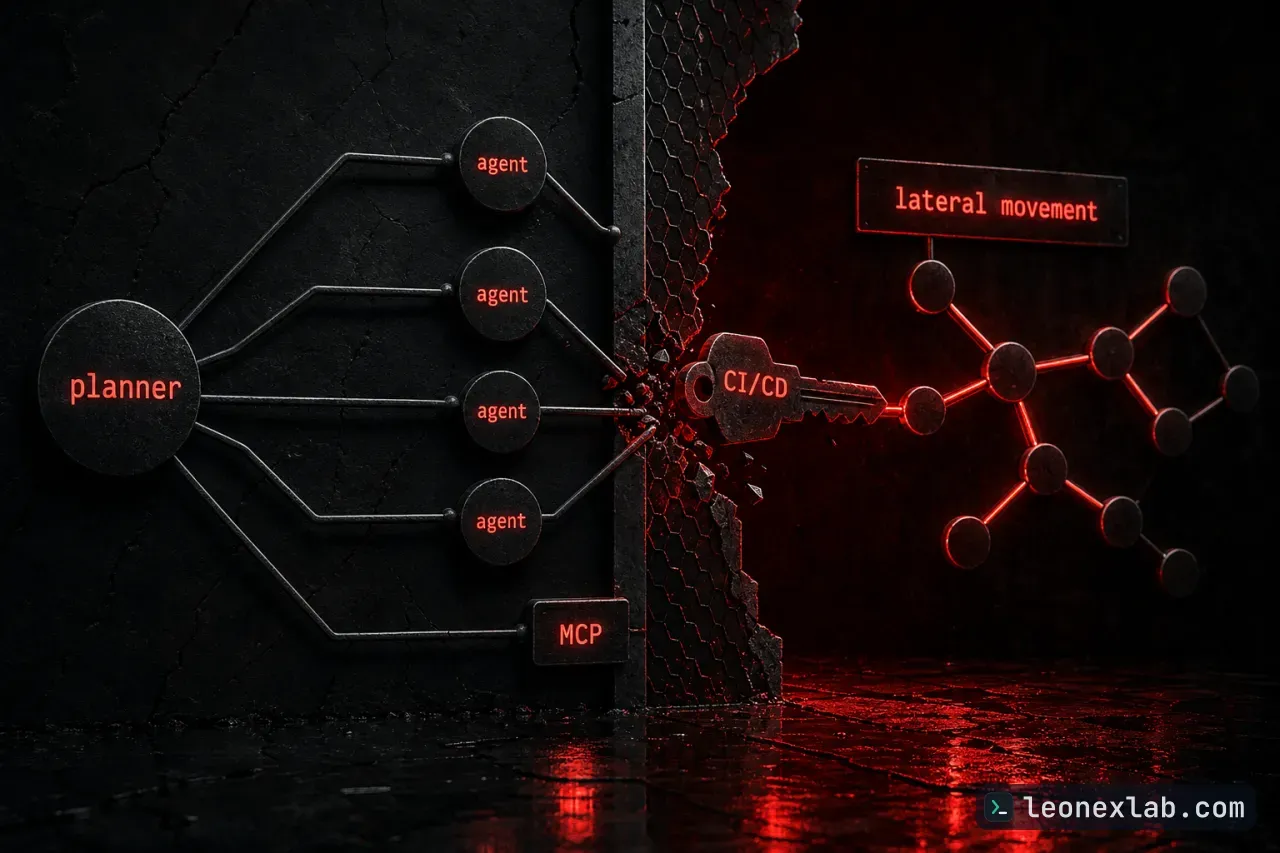
These open-source frameworks orchestrate AI agents to carry out many stages of the traditional Cyber Kill Chain at scale. They can plug into the existing Model Context Protocol (MCP) and connect standalone pentest tools in new ways. Some let operators specify the type of task. ARTEX and its forks map assets and environments onto a graph, so that multiple agents in parallel enumerate, verify, test and attack at reasoning speed. As a result, intrusion becomes a problem that can be climbed step by step, exactly the kind of problem agents are good at.
More than 50 LLM AI agents are currently being tracked. The five leading orchestrators are all very popular (over 1k GitHub stars) and fully autonomous. This autonomy is described as a doctrinal shift in cyber-attack capability:
Human skill is no longer the limit: the framework carries out every step of the OODA loop on its own, including observing the environment, orienting to prioritize valuable or vulnerable targets, deciding on an action, and acting.
Acceleration: multiple agents working in parallel toward one target is a big leap over one or more AI-assisted human operators.
Scale: a single operator can target many organizations at once, sharply increasing the blast radius.
Small mistakes are easy to spot: autonomous frameworks persistently and systematically test exposed services, including their configurations.
In terms of architecture, each tool has its own organization:
ARTEX (and its forks): a planner plus agents running in parallel, with a graph of goals, leads and findings linked to the graph of the target's assets. It has no built-in post-exploitation capability and requires user guidance.
LuaN1aoAgent: consists of a supervisor agent, a planner agent and general-purpose executor agents, using three graphs. It has built-in SSH and Chisel to create tunnels and retry connections after interruptions.
Decepticon: an orchestrator agent coordinates specialized sub-agents, using a goal graph with preconditions. It runs in a Kali container with root privileges, with dedicated skills for post-access, Active Directory and pivoting to the cloud.
Cairn: a dispatcher assigns work to existing AI harnesses such as Codex, Claude Code and Pi, using a graph of events and leads, where a new node triggers the dispatcher.
PentestGPT-Agent: one supervisor agent and one general-purpose executor agent, using a task list with dependencies, goals and evidence. It runs directly on the host and has no built-in post-exploitation capability.
Identity-based exploit chains: a real-world case
Over the past eight weeks, the Cloudforce One team has taken part in several incident investigations involving ARTEX and its derivative frameworks. In many cases, attackers gained initial access to a hyperscaler environment and then pivoted straight into the customer's Cloudflare environment. Root-cause analysis points to the same credential-hygiene failure: static, non-expiring tokens running in compromised CI/CD pipelines, granting broad cross-environment access. LLM frameworks significantly increase the likelihood that a customer's API key is used to take over other tenant environments.
In one specific case, ARTEX gained access to an account-level API token that had been used for CI/CD, with no IP restrictions or rate limiting. Evidence suggests the breach most likely originated from a third-party hyperscaler. Multiple new Worker scripts were created with distinctive names such as artex-*, artex-pgrecon-*, artex-pgw-* and artex-do-*, each corresponding to a specific behavior and often carrying a letter-number suffix. Activity exceeded 69 requests per minute across multiple parts of the Cloudflare infrastructure, along with 400 database dump requests in one hour. The team also recorded attempts to maintain access and to validate session tokens for other third-party applications. Although most of the activity may have been lightly guided by an operator, it is still an example of the speed and breadth these frameworks achieve after a compromise.
Modern Security Model: six pillars of defense
Reinforce the front gate: deploy a Web Application Firewall (WAF) with advanced rules such as rate limits. Traffic passes through distributed outer gateways that filter volumetric floods at Layer 3/4 and direct-IP probing, so only legitimate traffic reaches the main address.
A security checkpoint in the lobby: anomaly detection on every web application customers access. Clear rules apply, such as no knocking 500 times in five seconds, no disguising paths with tricks, no carrying away diagnostic heap dumps. Suspicious behavior is rejected immediately.
Spot the fake visitors: deploy Bot Defense. Automated agents, headless browsers and AI reconnaissance tools do not behave like real people, so Bot Defense and challenges detect the unnatural rhythm and push them out before they touch any door handle.
Eliminate back doors: deploy Identity-Gated Access for every high-risk web application, both external and internal, such as internal admin pages, /actuator diagnostic endpoints and remote access gateways. Zero Trust application access seals off the entrances from the outside. Outsiders see no door at all, and can enter only after their identity and device posture are verified, and are then led straight to the exact room they need.
Inspect deliveries: apply validated schemas and explicit security controls. Every request must pass OpenAPI schema validation, the sender must present a valid mutual TLS (mTLS) certificate, and requests that fail or lack credentials are rejected right at the boundary. Every positive security deployment ends with a deny-all rule at the bottom of the rule set (Default-Deny).
Neighborhood watch: deploy Threat Intelligence to gain visibility into attacks. When an actor stands up new command-and-control infrastructure or deploys a new tunneling technique, the system receives early warning, updates watchlists, tunes sensors and closes the gate before the attacker arrives.
In addition, make sure that people who have gotten in cannot break into the neighboring rooms. Micro-segmentation is an effective strategy to block lateral movement, keeping compromised credentials from moving from one system to production, test and development. The article also mentions deploying security keys and FIDO hardware keys.
Why the old models are no longer enough
ARTEX and similar frameworks pose a major challenge to traditional defense models. Even the defense-in-depth model, which emphasizes the classic network DMZ zone, cannot cope with today's complex architectures, and upcoming attacks will go even further as orchestration tooling becomes the new standard. For legacy and on-premises devices, an identity-based approach is needed to make them impossible to reach from the Internet. Alongside identity, micro-segmentation aims to slow down or make lateral movement noisier. This architecture favors an approach that puts containment of spread first, which is essential when users keep losing their keys.