Node.js security patch of 11/11/2026: what you need to upgrade
In this article
Release scope and updated dependencies
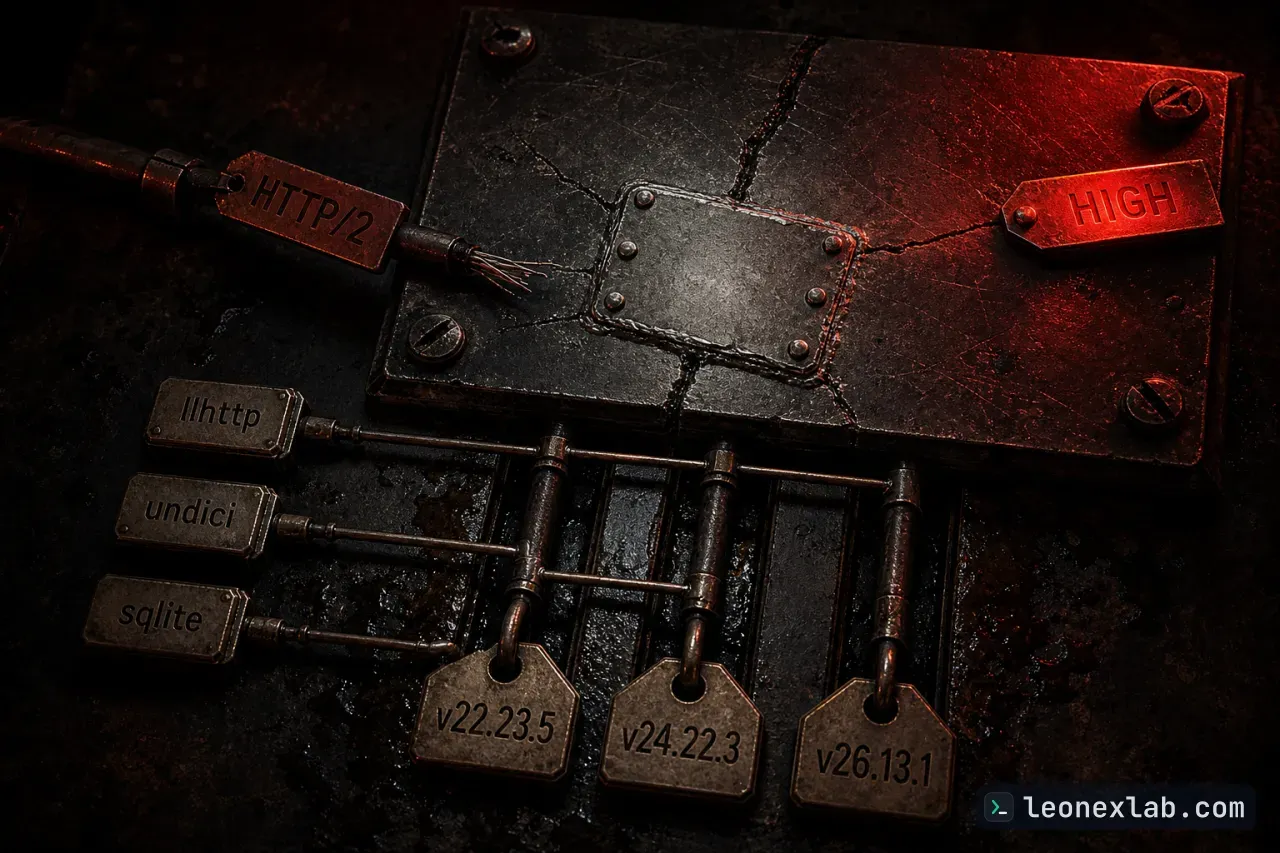
This security release updates the 26.x, 24.x and 22.x lines and also upgrades several dependencies to address publicly disclosed vulnerabilities. The libraries mentioned are llhttp on 22.x, 24.x, 26.x; undici on 24.x, 26.x; and sqlite on 22.x, 24.x. The downloadable versions are Node.js v22.23.5, v24.22.3 and v26.13.1.
The highest severity across all three lines, 26.x, 24.x and 22.x, is HIGH. Because End-of-Life versions are always affected whenever a security patch is released, users should use a version that is still supported according to the Release Schedule.
High-severity HTTP/2 vulnerabilities
HTTP/2 is the protocol with the most bugs in this round. The high-severity bugs include:
CVE-2026-123863: the assertion CHECK_EQ(current_nghttp2_memory_, 0) in ~Http2Session() can be triggered. A client can cause an Http2Stream that still holds a header buffer allocated by nghttp2 to outlive its session, making the memory check fail and the process abort. This is a variant of CVE-2024-27983 that the earlier fix did not cover. Affects 24.x and 26.x.
CVE-2026-123865: if a protocol error occurs while a session is shutting down, nghttp2 destroys the session itself but Node.js does not notice, leaving a dangling session. The socket gets stuck in CLOSE_WAIT and all of the connection's HTTP/2 state is held in memory indefinitely. An attacker can deliberately start the shutdown with GOAWAY(NO_ERROR). This is an incomplete fix of CVE-2026-48937. Affects 22.x, 24.x, 26.x.
CVE-2026-123866: a use-after-free when a stream is destroyed while a write operation is still under backpressure, causing freed or unrelated heap memory, including the response buffer contents of another connection, to be written to the socket. The bug can be triggered by an RST_STREAM from the peer or by the server's own per-stream timeout. Affects 22.x, 24.x, 26.x.
CVE-2026-123874: a use-after-free of Http2Stream when the server serves files with respondWithFile() or respondWithFD(). A client can cause the server to free the stream while a write request pointing to it is still in the socket queue, leading to server memory corruption. Affects 24.x and 26.x.
TLS and HTTPS vulnerabilities: memory leaks and authentication bypass
The TLS and HTTPS bugs are notable because they can expose sensitive data or break client-certificate authentication policy.
CVE-2026-123864 (high): a re-entrancy bug in HTTPS. When TLSWrap::DoWrite() is asked to write zero bytes, the function calls ClearOut() directly. If this write originates from JavaScript running inside the HTTP parser's on_body callback, ClearOut() decrypts the next TLS record while the parser is still processing the body, calling llhttp_execute() again and causing a use-after-free and an out-of-bounds heap read. As a result, an unauthenticated client can read the memory of other connections, including TLS private keys. Cleartext Node.js http is not affected. Affects 22.x, 24.x, 26.x.
CVE-2026-126051 (high): an uncaught exception that can be triggered remotely on a TLS server. When the server uses the SNICallback, OCSPRequest, newSession, resumeSession hooks or server.addContext(), OpenSSL callbacks are deferred, and the deferred code does not handle the case where the socket is destroyed between scheduling and execution. An attacker sends a padded client hello followed by a socket FIN so the socket is destroyed before the callback runs, causing the process to throw an uncaught exception instead of emitting an error event. Affects 24.x and 26.x.
CVE-2026-123872 (high): with TLS 1.2 renegotiation, a client can change the servername to bypass client-certificate authentication. On servers that apply different client-certificate policies per hostname, a client authenticated on an allowed host can renegotiate under a different servername and carry its existing authentication over to a more strictly protected host. Affects 22.x, 24.x, 26.x.
Medium- and low-severity vulnerabilities
At medium severity, this patch round addresses several memory, authentication and information-disclosure issues:
At low severity there are three bugs related to the Permission Model and zlib:
CVE-2026-123829: recursive fs.watch() on macOS and Windows exposes the names of files and directories the process is not permitted to read, because the kFileSystemRead permission is checked only once at the root directory. The bug exposes only names and timing information, not file contents. Affects 22.x, 24.x, 26.x.
CVE-2026-123862: calling a pending params() and then destroy() on a zlib stream throws an uncatchable ERR_INTERNAL_ASSERTION, causing the process to abort. Applications are affected only when they call deflate.params() while streaming to a peer. Affects 22.x, 24.x, 26.x.
CVE-2026-106071: a wildcard rule of --allow-fs-read or --allow-fs-write can match paths shorter than the grant's prefix. For example, --allow-fs-read=/etc/passwd.* also allows reading /etc/passwd. The bug requires a wildcard grant located directly under the root of the permission tree. Affects 22.x, 24.x, 26.x.
Release timing and how to follow updates
Key points
The security patch of Wednesday, November 11, 2026 applies to the 26.x, 24.x and 22.x lines, with a highest severity of high.
Most of the bugs are in HTTP/2 and TLS, allowing unauthenticated clients to crash servers, leak memory or bypass certificate authentication policy.
Many of the bugs are variants or incomplete fixes of earlier CVEs, such as CVE-2024-27983 and CVE-2026-48937.
End-of-Life versions are always affected when a security patch is released, so you need to use a version that is still supported according to the Release Schedule.
The patch is released as Node.js v22.23.5, v24.22.3 and v26.13.1.